


Startup Daily TV: Sydney startup Diraq is rewriting the rules on quantum computing




These new mechanism is less bulky and requires fewer parts, which could prove essential to making large-scale silicon quantum computers a reality.
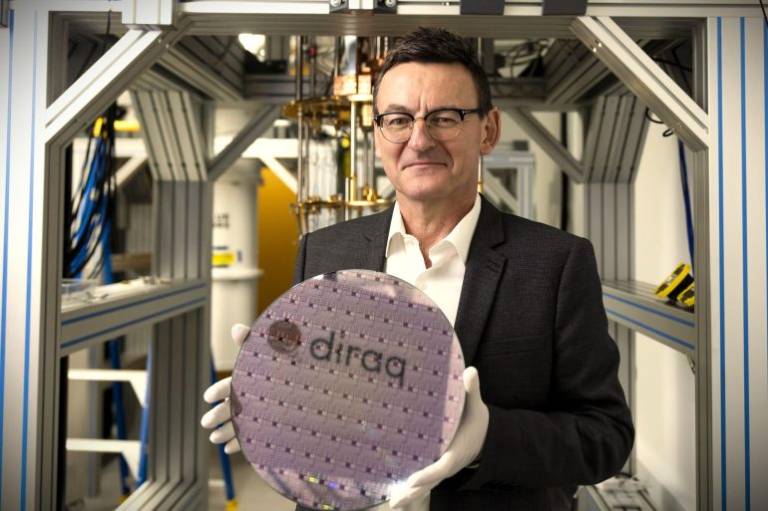
The serendipitous discovery, made by engineers at the quantum computing startup Diraq, which spun out of UNSW Sydney, is outlined in the journal Nature Nanotechnology.
Lead author Dr Will Gilbert, a quantum processor engineer at Diraq, said logic gates are the basic building block of all computation; they allow ‘bits’ – or binary digits (0s and 1s) – to work together to process information. a quantum bit (or qubit) exists in both of these states at once, a condition known as a ‘superposition’. This allows a multitude of computation strategies – some exponentially faster, some operating simultaneously – that are beyond classical computers
“This was a completely new effect we’d never seen before, which we didn’t quite understand at first,” he said.
“But it quickly became clear that this was a powerful new way of controlling spins in a quantum dot. And that was super exciting.”
While experimenting with different geometrical combinations of devices just billionths of a metre in size that control quantum dots, along with various types of miniscule magnets and antennas that drive their operations, Dr Tuomo Tanttu stumbled across a strange effect.
“I was trying to really accurately operate a two-qubit gate, iterating through a lot of different devices, slightly different geometries, different materials stacks, and different control techniques,” said Dr Tanttu, a measurement engineer at Diraq.
“Then this strange peak popped up. It looked like the rate of rotation for one of the qubits was speeding up, which I’d never seen in four years of running these experiments.”
What he’d discovered, the engineers later realised, was a new way of manipulating the quantum state of a single qubit by using electric fields, rather than the magnetic fields they had been using previously.
Since the discovery was made in 2020, the engineers have been perfecting the technique – which has become another tool in their arsenal to fulfil Diraq’s ambition of building billions of qubits on a single chip.
“This is a new way to manipulate qubits, and it’s less bulky to build – you don’t need to fabricate cobalt micro-magnets or an antenna right next to the qubits to generate the control effect,” said Gilbert.
“It removes the requirement of placing extra structures around each gate. So, there’s less clutter.”
Controlling single electrons without disturbing others nearby is essential for quantum information processing in silicon. There are two established methods: ‘electron spin resonance’ (ESR) using an on-chip microwave antenna; and electric dipole spin resonance (EDSR), which relies on an induced gradient magnetic field. The newly discovered technique is known as ‘intrinsic spin-orbit EDSR’.
“Normally, we design our microwave antennas to deliver purely magnetic fields,” said Dr Tanttu.
“But this particular antenna design generated more of an electric field than we wanted – and that turned out to be lucky, because we discovered a new effect we can use to manipulate qubits. That’s serendipity for you.”
Speaking to Startup Daily TV Prof Andrew Dzurak, CEO and founder of Diraq, and a Professor in Quantum Engineering at UNSW, quipped that Diraq was a “25-year overnight success”.
He led the team that built the first quantum logic gate in silicon in 2015 and the new mechanisms they’ve developed are the result of more than two decades of research.
“It builds on our work to make quantum computing in silicon a reality, based on essentially the same semiconductor component technology as existing computer chips, rather than relying on exotic materials,” he said.
“Since it is based on the same CMOS technology as today’s computer industry, our approach will make it easier and faster to scale up for commercial production and achieve our goal of fabricating billions of qubits on a single chip.”
CMOS (or complementary metal-oxide-semiconductor, pronounced ‘see-moss’) is the fabrication process at the heart of modern computers. It is used for making all sorts of integrated circuit components – including microprocessors, microcontrollers, memory chips and other digital logic circuits, as well as analogue circuits such as image sensors and data converters.
“Today’s CMOS chips – with billions of operating devices integrated together to work like a symphony, and which you carry in your pocket – that’s an astounding technical achievement, and one that’s revolutionised modern life,” Prof Dzurak said.
“Quantum computing will be equally astonishing.”
To hear more from Prof Dzurak and Diraq’s breakthroughs, click on the link below.
You can turn into the Startup Daily show Monday to Thursday from 2-2.30pm on ausbiz.com.au, for the latest news in tech and startups.
If you can’t make it, then you can always catch up on what our guests had to say on demand via Startupdaily.net/tv or via ausbiz (it’s free to sign up).

Debra Benita Shaw is a Reader in Cultural Theory at the University of East London. She is a critical posthumanist interested in the relationship between technology, architecture and what it means to be human. She is also a literary critic specialising in science fiction. Her most recent monographs are Posthuman Urbanism (2018) and Women, Science & Fiction Revisited (2023).
Comments