


Nanosatellite company Myriota announces first commercial IOT product


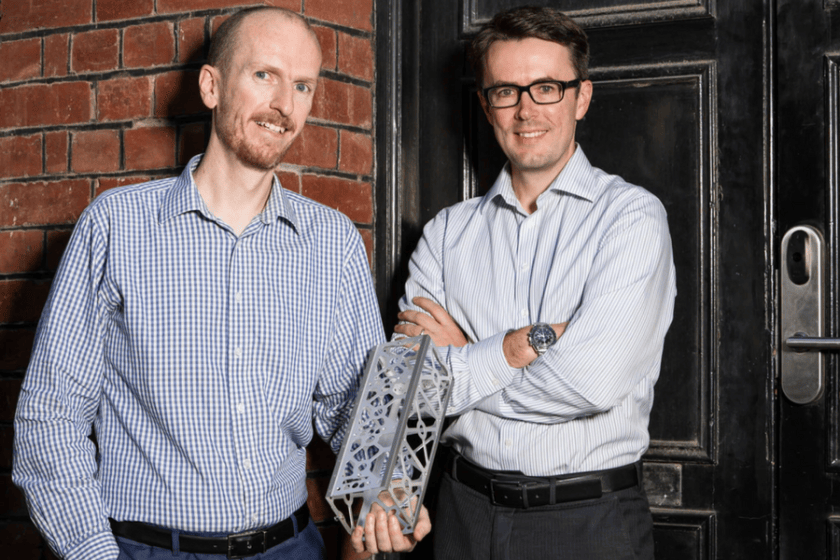

The South Australian company has partnered with fellow Australian business Davey Water Products to add its Internet of Things (IoT) connectivity to Davey’s TankSense product range, enabling farmers to receive water level data direct to their mobile phones.
The product is expected to be commercially available in the second half of the year and will be the first mass-market water-level sensor to be connected via Myriota’s low-cost earth-to-satellite transmission technology.
It will help farmers manage water usage and monitor livestock water supply in areas where cellular networks are unreliable or unavailable.
Myriota CEO Dr Alex Grant said the product would benefit farmers who had faced exorbitant costs for satellite connectivity in the past or struggled to reliably monitor their water systems via existing technology.
“Our technology removes the need for farmers to rely on cellular networks with patchy coverage, or spend large sums of money to connect to high-cost satellites,” Dr Grant said.
“We’re excited that this partnership will lower the cost of water management in locations that up until now have had no cost effective way of retrieving data.”
Myriota launched its next generation of technology on Spaceflight’s SmallSat Express mission aboard Falcon 9 late last year.
Myriota Business Development Executive Tom Rayner said the Davey Water Products sensor was the first of a number of new product announcements the company expected to make in the coming weeks.
He said while agriculture was an important industry for Myriota, it was also working on products for utilities metering, environmental monitoring, defence and in the asset tracking and logistics space.
“We’re working with dozens of companies across a whole range of industry verticals and there are quite a few products in development,” Rayner said.
“This is the first one we’ve announced and given the profile of Davey it’s one that we’re quite pleased about.”
Myriota has been scaling up since it was spun out of the University of South Australia in 2015 and last year raised $15 million through a Series A funding round, with Boeing HorizonX Ventures among the contributors.
Rayner said 2019 would be the year the company’s products hit the mass consumer market.
He said demand for the Davey product would be strong among farmers in Australia’s vast Outback and globally.
“It’s a huge issue for people in Australian agriculture that they don’t have access to reliable, low-cost communications infrastructure, particularly for these IOT applications where the cost has to be ultra-low to make them work so we see a lot of demand here,” Rayner said.
“But anywhere that you can’t justify the installation of a terrestrial-based tower this technology has got a place so we’ve already had strong demand for this product in North and South America, Asia and New Zealand – it really is global.”
Davey’s sensors are bolstered by their inbuilt AI capability, which rely on algorithms to increase the accuracy of predictions around when a tank will run out of water.
Davey Water Products General Manager Innovation Joel Gresham said the combination of the TankSense product with Myriota’s technology would provide a world first in terms of communicating with remote locations.
“We launched the first AI driven monitoring and control app for tank water management last year and now, we’re embarking on another world first,” Gresham said.
“Thanks to Myriota’s low cost satellite technology, farmers who have traditionally needed to manually check their tanks will now be able to monitor their assets seamlessly from any location.”
South Australia has been a major player in the nation’s space industry and is home to major Tier 1 defence companies and several emerging space start-ups.
In December, the state’s capital Adelaide was announced as the home of Australia’s new space agency.
Meanwhile, another Adelaide-based IOT space company Fleet yesterday announced in Amsterdam its plan to connect 1 million LoRaWAN devices around the globe for $2 per device per year.

Debra Benita Shaw is a Reader in Cultural Theory at the University of East London. She is a critical posthumanist interested in the relationship between technology, architecture and what it means to be human. She is also a literary critic specialising in science fiction. Her most recent monographs are Posthuman Urbanism (2018) and Women, Science & Fiction Revisited (2023).


Comments