


A female founder explains why women are wasting their time trying to raise capital in Australia



There is a gap in venture funding in Australia, and it’s getting worse. It seems as if Australian investors in particular are struggling at how to fund female founders equitably.
Right now we get around 1.2% of funding, but make around 40% of new businesses.
Some of my research, alongside the work of Harriet, the Singapore-based organisation helping female founders raise capital, indicates that even before you talk to an investor (of any sex) you are behind the 8-ball as a woman.
You just don’t get treated the same way, even before you talk to anyone. Harriet is deliberately doing things differently to change this and it’s starting to forge new ground for women.
First of all we sat down and thought about the networks. Basically, most investors are still men, and they still only know, and follow, male founders, so the entry into the pipeline is quite restricted.
As Jason Calacanis stated in his famous book “Angel” men preference the men they want to be “like”. I wonder when was the last time a middle-aged man wanted to be a woman?
Harriet tried multiple ways to create a wedge into multiple networks over the past six months, but it simply didn’t work. These are fundamentally closed groups, just for men. Even if you are invited, you are still “alien”, so it’s a polite conversation, but you won’t be offered a seat or a drink or asked to hang around.
So Harriet took a big step and organised an event unlike any other (more on this later), and these networks didn’t open. But hey, they were willing to venture out to meet us aliens regardless and they actually loved the experience, so they’ll be back!
So I did a whole thesis on Chaos Theory at one stage, and I can tell you, chaos theory applies here.
You know that bit about the butterfly flapping its wings and a hurricane starts half around the world? Well, that is what conversations with investors look like.
We have a fundamental bias about women being “bad with money” or that “women spend money, men make it” which comes from decades of post-Victorian nonsense about women having to be in the home, and men in the workplace. If you think you don’t have it, sorry, but you do. It’s that strong.
Given that female founders make more than twice as much money for investors as male founders do, it’s also clearly bull…dust. But these myths often are.
It was also a status symbol after WW2 if your wife didn’t have to work, you must have more money, so there’s some male pride to contend with too.
So how does this bias play out?
Basically, it makes investor conversations with female founders very unproductive and largely a waste of their time.
Here’s where the butterfly flaps its wings.
The very first question that female founders get is always about risk. For the sake of understanding what is going on here more clearly, I am going to call these “anti-growth” questions.
Research tells us that women are asked “anti-growth” questions, and men are asked “pro-growth” questions.
So, for example, if the question is about revenue targets, women are asked “what happens if you don’t hit your revenue targets”, whereas men are asked “what will you do next, after you hit your revenue targets”.
Quite a big difference.
Men get to talk about next markets ie. growth, women are talking about how they might bridge ie. “manage risk”!
And as the human brain has a horrible confirmation bias problem, if we start the conversation talking about risk, we tend to end it that way.
So you end up with a conversation that confirms… “this business is high risk and has low growth potential” = don’t invest. This is the “anti-growth” butterfly.
Whereas male founders get the growth butterfly so they end up with “this business is low risk and has loads of growth potential!” = invest
The initial question is the butterfly, the initial condition, and the end result is the hurricane – upwards flow for men and downwards flow for women.
So, we need to always start conversation with a female founder talking about growth, and female founders need to put growth in the answer to every question – it won’t work for every investor I am sure, but it might push the dial over a bit.
What this led to was a fundamental understanding that, due to the butterfly effect mentioned above, and the effect of crowd thinking (or groupthink if you are technical about this) – if you allow an audience to ask questions of female founders at pitch events, you will “turn the crowd” to think the idea is high risk and low growth.
So Harriet’s first female founder event canned the questions, and as a result it was a much more upbeat affair! Much more like an all male founder pitch session where the crowd was cheering and encouraging, it was actually fun! The initial conditions were changed.
These are some great tips I’d love to see the whole ecosystem in Australia embrace, but I think even more powerful would be for investors to accept that they are not doing this sufficiently differently to move the dial, and get in touch with Harriet – Harriet are moving the damn dial already and it’s working! Don’t try to reinvent the wheel, talk to them, and just do what they say. It will feel weird, but that’s what “alien” tends to feel like.
In Australia, I have been “mansplained” to more times than I can count, I was counting for a while but I gave up when I hit the 30s.
I recently had a lawyer investor try to tell me how mental health works (I am a senior psychologist with around 30 years of experience) and how children are not smart enough to do x or y (this person didn’t have kids).
And because it’s a small world, if I pipe up and say “actually I am the expert here”, I become a nasty complaining, ungrateful “alien”. So, that’s not a winning plan either.
Instead I gently thank them for their feedback, gritting my teeth the whole time and try to redirect the conversation back to my expertise. Once I was asked to “get us a tea”. It’s plain insulting.
I knew one female founder who deliberately “dressed sexy” so that she would get more money.
I have known multiple female founders who have been asked out on “dates” to secure funding. This is, of course, more than insulting, it’s abuse. And for less than 1.2% of funding… it’s a really low benefit from a female founder loss that is lifetime in effect.
I have also been in the room with a number of male founders who were not technical experts in their field, and not even coders, but were never spoken to in that way.
Instead, investors focused on, you guessed it, growth. What a surprise.
Harriet worked out very quickly that the advice they were getting for their female founders who were trying to raise was just fundamentally nonsense for women, and wasted their time.
For Gheorg is was things like: “mental health is not a business”. I suppose, if you can’t see me as an expert, you might think it reasonable, hence why the insult problem is actually quite a big one.
I’ve also been told to “wait for the investors to come to you” – OMG if I did that Gheorg would not be where he is today. He would just be a skeleton sitting on a digital shelf.
Nope, I won’t be waiting for anyone, thanks, certainly not magically appearing investors.
So, Harriet had to make a fundamental choice here: are they in the business of education of those who are struggling, or are they in the business of making money? They chose the latter. Good on them!
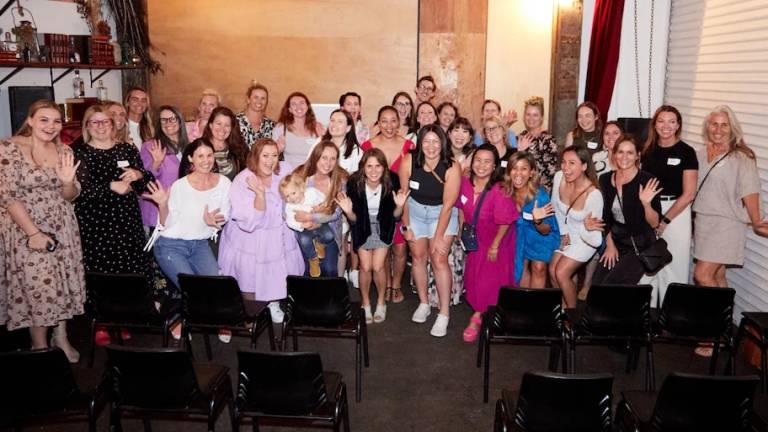
As a result they ran a very different event which changed the conditions for investors, and made their time with three amazing female founders (me, Rebecca Grainger from Triiyo and Tracy Tardia from Hipajak) very productive for the first time ever!
Their thesis goes that… since they are quite a stretch along in solving the “female founder problem”, the smart people will join in, and we saw that at their inaugural event with BCapital, Wavemaker Partners, Wavemaker Impact, 1982 and Artesian (and their $100 million Female Leaders Fund) being front and centre.
So the equation looks like this: female founders = 2x the returns, funds that have more of them = more successful.
So if you’re an Australian investor reading this, it’s a no brainer. Don’t try and reinvent the wheel, talk to Harriet. They are already 3000 steps ahead and your competitors are probably already talking to them – time to catch up.
If you’re a female founder, keep talking about growth and consider going overseas to get your funding. The conversations are much more productive for everyone.

Dr Hon Weng C., a Forbes 30 Under 30 laureate, is the founder and CEO of Cortical Labs, where he is pioneering the development of the world’s first biohybrid computing platform. With a background in medicine and technology, Hon combines synthetic biology and AI to innovate in the field of computing. He holds patents in medical voice command devices and is a winner of the Imagine Cup Australia.
Comments