


How Perth startup Formalytics took on the official FIFA app during the 2018 World Cup
Perth’s Formalytics is one of the breakthrough stories in the Australian tech industry in 2018, its app myKicks climbing the rankings during the World Cup.


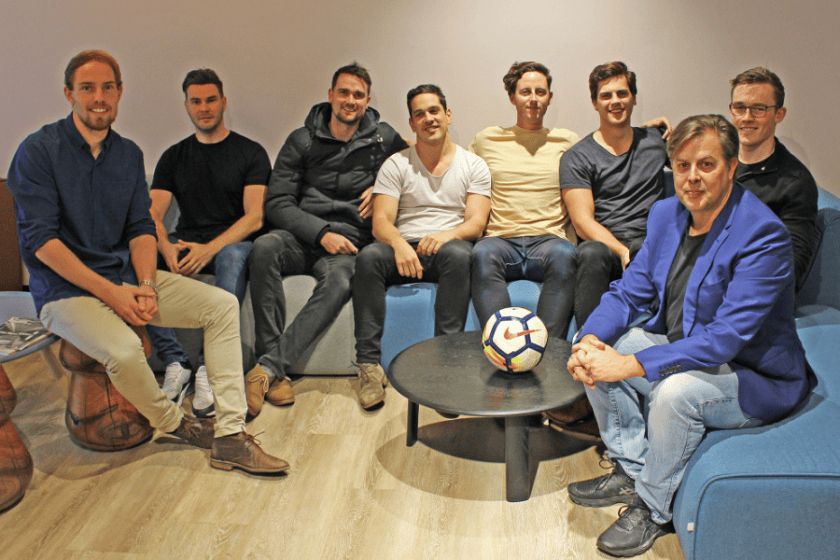

Perth-based startup Formalytics is one of the breakthrough stories in the Australian tech industry in 2018.
The company developed technology from the ground up that utilises computer vision and augmented reality which turns any ball into a smart ball through a mobile device.
Their first product, the penalty kick app myKicks, surged to number one on the UK App Store during the 2018 World Cup, dethroning the official FIFA World Cup app during the tournament.
With a marketing strategy of targeting the teenager to early 20s demographic and working with key influencers, the app proved to be a viral hit.
With data collected on over 350,000 amateur penalties and growing, myKicks are building the world’s largest database of penalties recorded.
In this interview, Formalytics cofounder Andrew Hall talks about his company’s journey taking in near deaths, close misses then breakthroughs. It’s a lesson in staying resilient.
You used influencers, YouTubers and the like which played a part in your app going number one on the UK app store. You have said those kinds of people can help your company build a community, therefore what is the attitude that myKicks as a brand wants to convey?
We’re edgy and we’re grassroots. We want that authentic connection with what we see as the grassroots of football. It’s not just going down to the park and training it’s playing FIFA, it’s juggling, tricks, watching YouTubers and following them. So we want to get inside that community and work with them to bring the product through effectively.
And you always felt that was going to be more effective than partnering up with your elite footballers and clubs?
It was literally from the start. I remember watching a Miniminter video, which now has more than 15 million views, and thinking about the power of the way he presents and doing it in an authentic manner, and we went ‘hold on a second, that’s our audience, that’s what they’re doing down the park, fun challenges, that’s totally the way for us to connect’.
Do you want to see yourself in the entertainment, gamification realm or do you push to become a part of grassroots training? How do you reconcile the push and the pull between going deep into football, which becomes more training over entertainment, or do you apply your technology to be fun and entertaining?
In our investor pitches now we are talking about being at the intersection of esports and physical sports. It’s just this new category that’s emerging. Our philosophy is at the core of it it’s about skill improvement, but if it’s not fun or entertaining it’s not going to happen because youngsters expect so much more these days.
Have you considered going down the training route?
We are. The penalty kick product is just our first product. Now we’re pushing into longer range kicks which people do a lot more of as well.
Where you might practice penalties infrequently, you practice longer kicks far more often, we’ve got a tonne of ideas that are based on academic research about how to go about measuring those kicks, how to quantify them but making it fun like our penalty kick product because that’s the key to long term engagement.
I’m a massive football fan and I do stuff like crossbar challenges, can that be developed?
We’re looking at things like using augmented reality to literally put targets on both posts and then your score is a function of speed and distance away from that target and what people have shown academically is over 10 kicks you can really segment people between pros and amateurs doing this type of test.
Again the fun and entertainment aspects has the larger market potential and cut-through?
Absolutely. A lot of sports tech companies focus on the elite, that’s not where we are. The ultimate value is building a community of people that want to interact.
Of course you’ve had excellent traction in the UK and very good take up in the US too. Apart from being number one in the UK app store during the World Cup, the app is still hovering in the top 100-200 in both app stores.
We haven’t done a piece of marketing since July 8th. It’s all been off since then to have a look at all the fundamental viral coefficients that’s been going on in that time. For us it was a test to prove that the audience will engage with this new type of product category and then turn the marketing off and see what happens and it’s still rolling through.
Given what you’ve learnt, what’s the next steps?
We’ve starting discussions with a bunch of partners around this first product being myKicks penalties as a deep fan engagement tool. Partnering with them effectively whether it be a league or a world championships of penalties hosted by a club and we can scale the participation infinitely through the app.
They’re the sort of discussions we’re having at the moment over how we can leverage this first product, which is fan engagement, and in the background there’s a hell of a lot of work going on in the longer-range kick product which we believe is the mass consumer product.
Around 10,000 professional penalties were analysed for myKicks, what types of analysis and data points were considered?
We were really lucky, we found penaltyplots.com and this site had done a lot of work on annotating penalties themselves. But here was an enthusiast, and there’s a lot of these enthusiasts around the world who are creating their own data sets because they’re quite valuable, who had done an amazing job on 10,000 pro penalties and basically came up with a probability heatmap of a ball’s crossing point on the goal plane.
We could then infer speed because we know how fast the professionals kick and then we do a whole algorithm that derated that for different speeds.
We can now give a probability of a goal on each shot through its crossing point and speed and so we then went back through Neymar’s, Lionel Messi’s and Cristiano Ronaldo’s last 50 penalties, ran it and was within five percent of expected goals.
What about outside the football realm? Do you have ideas that you wish to deploy your technology outside of it?
Oh yes!
We’ve publicly said in the past we’re a ball sport quantification platform. What we do a bit differently to everyone else is, there are other people in the market or they might focus on a different sport like basketball. As an example, there was a company called Athla a couple years back who had a lovely speed tracking app but they were really just looking at two-dimensional trajectories.
This is where it gets really complicated when you take a series of ball candidates through a series of frames, clean up the noise around it because there’s a lot of noise and then recompute three-dimensionally. That’s where we’ve spent 18 months and two million dollars to be frank and that’s the head start that we have. We can do more complicated things than other people can do that’s why we have a basketball prototype, we have a cricket prototype effectively in the works, we’ve looked at a tennis ball.
For us, let’s focus on football, get the penalty kicks right as the technology works really well up to 13 metres and now we’ve cracked new techniques that has enabled us to go to 20 metres with higher accuracy which opens up that longer range kick product.”
You are planning to raise another $1 million in convertible notes shortly, how will you use the new funds?
What we felt we had to do was prove that the new distribution channel worked through the influencers on our first round of investment, build the technology platform which was most of our first focus and then the people that use it and engage with it. Now that we’ve done that we’re ready to go to the mass consumer product.
We made a decision about nine months ago whether we do long-range kicks or penalties but we felt the technical risk was too much to go for just the long-range kicks.
Now we’re raising funds to finish off that next layer of the consumer product as it’ll have all-year round retention as you practice long-range kicks more frequently.
Do you have issues with user retention right now?
At the core of it penalties are fun and exciting but it’s not something we believe people will do month in, month out. That’s where the whole tournament infrastructure came from and what we see quite clearly in our data is those people that engage with the social features and the app around sharing, tournaments and finding matches, they’re the ones that have incredibly high day 28 retention.
How do you act on poor feedback, poor user experience?
That’s why you do so many betas before you launch. We did nine betas before the World Cup launch. Our biggest thing has been teaching a user how to use a highly complicated piece of technology in a simple way and the user experience around setting up augmented reality because a lot of users that download our app haven’t had much experience with AR before.
One of the greatest hacks of all time for us which dramatically increased the amount of people kicking was you do need to hold the phone still and so what happens is we ended up working out from a YouTube video how to hack together a tripod with a coke bottle and a pair of scissors! Who would have thought right, but that had dramatically different levels of engagement and uptake.
Why are you in Perth? Why not Sydney, Melbourne or London?
Home is where your mother in law lives and mine lives in Perth.
To take you back to how this company started. I’d sold a company, I was a bit bored and my long term mentor said he’s got a friend who’s got a sporting app that he wants to develop and if I could help him. I thought ‘sure it was consulting, so why not.’ About a week I was like, ‘I can’t take your money, this is a really bad idea,’ and he doesn’t mind me talking about this publicly because it was such a bad idea.
Then I thought there was something in this mobile, sport, tech nexus it was just a matter of finding the right sport. So I said ‘put the money into a central pot and see what we could do, whether we could build a company.’ That’s where it started.
I then found a young Aussie guy who was at MIT and Harvard at the time by the name of David Budden, he was the RoboCup soccer world champion. So what does robots have to do with what we’re doing? It’s a single camera system and highly constrained processing power pretty similar to a phone. David and I started talking, he was ex-Google, and then we said we needed to build a development team.
We then found Holly Ade-Simpson who David brought from Google and then Holly brought Team New Zealand and brought them all to a startup house in Mt Lawley. For 18 months we literally had seven people sleeping in corners, working through the night building this code, it was incredible times.
In that time, was the idea ever likely to fall over? How many times could it have ever fallen over?
Heaps!
So close to death?
There were times when we didn’t know how to get out of this, and we’re burning cash.
The problem is really complicated, you’ve got HawkEye which has six cameras and unlimited processing power and it’s an amazing system. We don’t, we’ve got one camera and a phone, so the first thing was getting the ball candidate detected right. We spent 12 months and we’d find the ball candidate, but it would be the wrong radius size and because of that we’d have the wrong trajectory path.
Then we finally cracked it, how do you get a tight lock around the real ball in those 300 video frames. Computer vision techniques are notoriously inaccurate. You’ll get a signal on the ball but it’s not the right size and you’ll get a plethora of noise around the ball because of the techniques you use that think the tree is a circle, the nets are a circle, head and feet are circles.
We spent 18 months getting that lock around the ball right and then cleaning up the noise around it and to be honest we had dozens of near death moments in that time.
Then we finally got it and then we had to run it on a phone. We’re basically running a phone like an A380 when it’s built to run like a Cessna. We’re kind of hacking the phone a bit in its GPU/CPU interplay to enable us to do this, it’s totally designed not to do what we’re doing but we hacked through that system to make it work.
When we first started it was ten minutes on one frame on a desktop for 300 frames, we’re now down to five seconds for 300 frames on a phone. First section was, find a ball, find the right ball without noise, get that to run at any speed that represents a consumer level product on a phone.
I actually remember in London in September last year and we were preparing to do a launch in November there was this one ball type that was giving us a lot of problems. It was the official EPL ball, then we realised it was the most popular ball in the UK at the time and we had to solve that problem. Yet the team did it.
Every ball is frequently different, the panelling, patterns, the feel. Each World Cup, for example, a new ball is released for the tournament.
That’s the power of where we got to, we’re literally ball agnostic now.
You’ve got a small team right now, what kinds of people are you going to expand the team with?
We plan to bring in some more engineers. There’s sort of two keys to being successful, there’s the backbone of the technology product which is a very different skill set to the app. We want to do more work on the backbone of our technology product to make it applicable to more sports.
Then there is this growth hacking piece, I know it’s an overused term but literally every month we’re doing a release we’re monitoring all the flows through the app and we’re always learning something about what features we are seeing the greatest amount of retention and activation and then recasting the app to present those features to users earlier in the flow. That’s equally as important as the core tech background.
This article first appeared on Bullpen, a site that focuses on the Australian sports business, sportstech and the sports startup ecosystem.
Image: the myKicks team. Source: Supplied.

A numbers nerd and ex-accountant (CPA), Clare Wood is not your average bean counter. As a money mentor, she uses her number powers for good to help entrepreneurs transform their money mindsets by following her proven frameworks to create big business profits.

Comments